Commercial Space For Lease In Flagstaff AZ: What Tenants Should Know

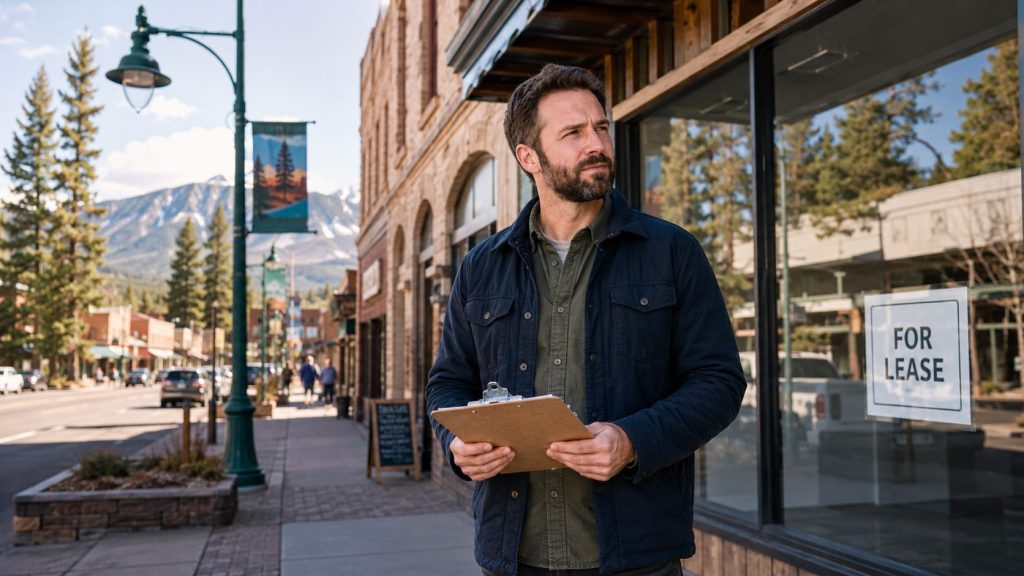
Commercial space for lease in Flagstaff AZ can look simple online, but the real decision comes down to rent structure, parking, permitted use, lease term, and whether the location actually supports how your business operates.

Here is the part many tenants miss: two spaces with the same square footage can create very different monthly costs and day-to-day headaches. One might have better visibility but limited parking. Another might have a lower quoted rent but higher operating expenses. A third may look perfect until zoning, signage, build-out, or use restrictions slow down your opening.

If you are comparing a Flagstaff office lease, a retail lease in Flagstaff, or a flex or industrial space near Route 66, this guide will help you look past the listing photos and ask the right questions before you sign.

As your local leasing advisor, my goal is to help you compare options clearly, protect your time, and avoid lease terms that do not fit your business plan. Flagstaff is a unique commercial market, shaped by tourism, Northern Arizona University, healthcare, downtown activity, Route 66 traffic, and mountain-town logistics. That local context matters.

According to the U.S. Census Bureau, Flagstaff had an estimated population of 77,539 in 2024, with 2022 retail sales of about $2.898 billion and accommodation and food services sales of about $601.58 million. That mix helps explain why location, parking, and customer access are so important for local commercial tenants. Source: U.S. Census Bureau

ChatGPT Image May 15, 2026, 12_50_50 AM

What should tenants compare first when looking for commercial space for lease in Flagstaff AZ?

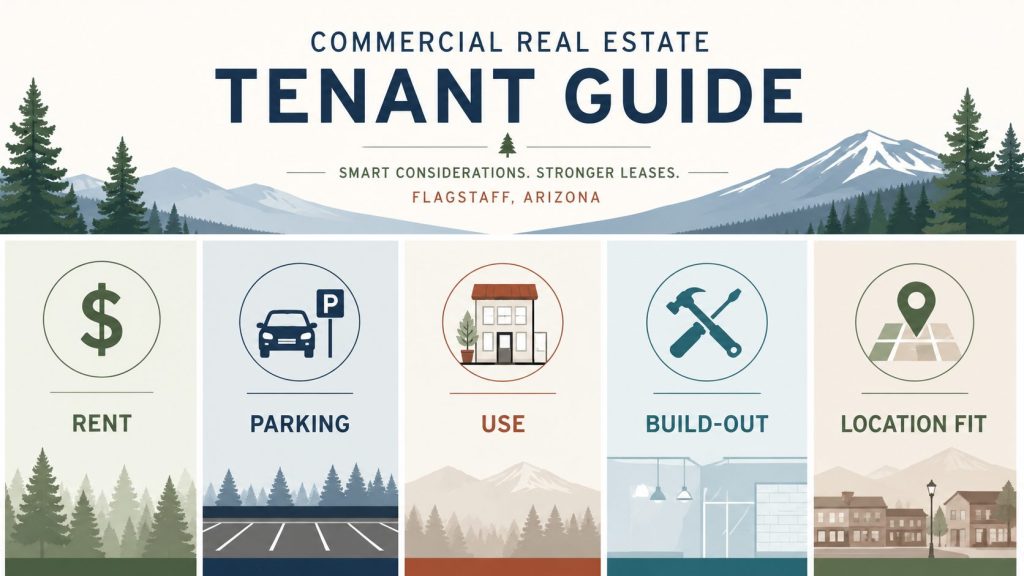
Tenants should compare total occupancy cost, allowed business use, parking, customer access, lease term, and build-out needs before focusing on rent alone.

The asking rent is only one part of the real cost. A space advertised at a lower rate may still cost more after common area maintenance, utilities, insurance, taxes, repairs, signage, and tenant improvements. Most business owners think the “best deal” is the lowest rent. In commercial leasing, the best deal is usually the space that lets your business operate profitably with the fewest surprises.

Flagstaff listings vary by property type and corridor. PropertyShark shows commercial real estate options in Flagstaff that include office, retail, coworking, and other property types, while Showcase lists Flagstaff spaces across office, retail, industrial, flex, medical, coworking, and land categories.

Start with these comparison points:

    • Rent type: Full service, gross, modified gross, NNN, or percentage rent.
    • Monthly cost: Base rent plus pass-through expenses, utilities, taxes, insurance, and maintenance.
    • Use fit: Whether your specific business is allowed by the lease and local zoning.
    • Parking: Customer parking, employee parking, delivery access, ADA access, and any reserved spaces.
    • Visibility: Signage rights, storefront exposure, traffic counts, walkability, and neighboring tenants.
    • Build-out: Who pays for improvements, permits, fixtures, HVAC, plumbing, electrical, and restoration.
    • Flexibility: Renewal options, expansion rights, assignment, subletting, and early exit options.

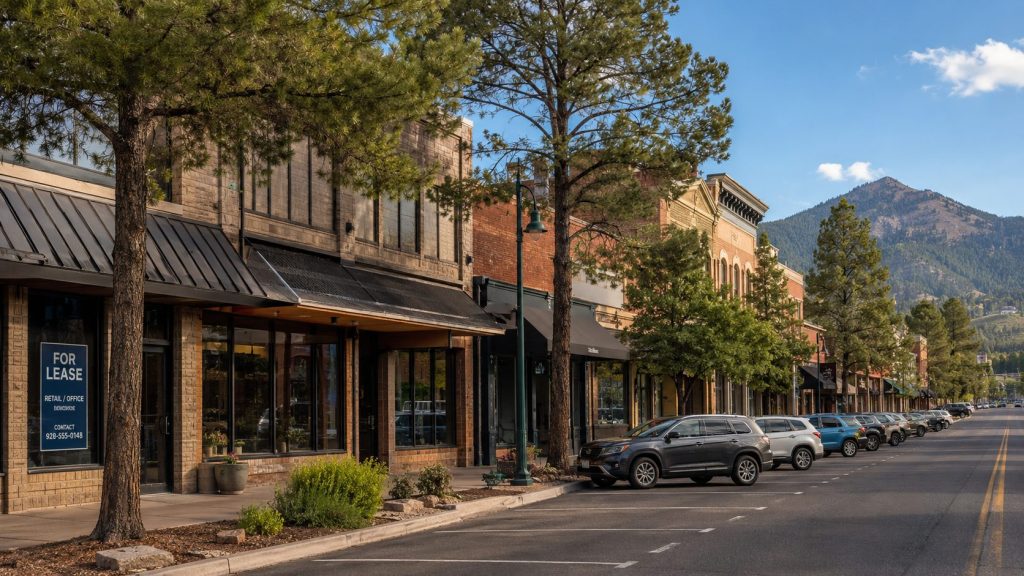
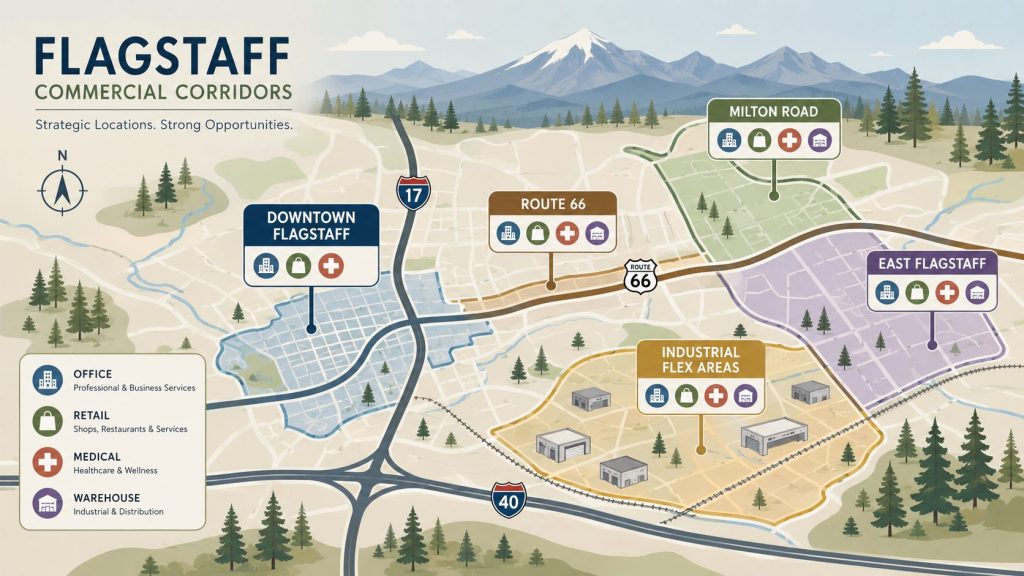
For example, a downtown retail space may offer stronger walk-in traffic and tourism exposure, while a Route 66 or east-side location may offer easier vehicle access and parking. Which one is better? The answer depends on how your customers find you, how often deliveries happen, and whether employees need convenient all-day parking.

Takeaway: Do not compare spaces by rent per square foot alone. Compare the full operating picture

ChatGPT Image May 15, 2026, 01_25_54 AM

How do commercial lease terms in Flagstaff affect your real monthly rent?

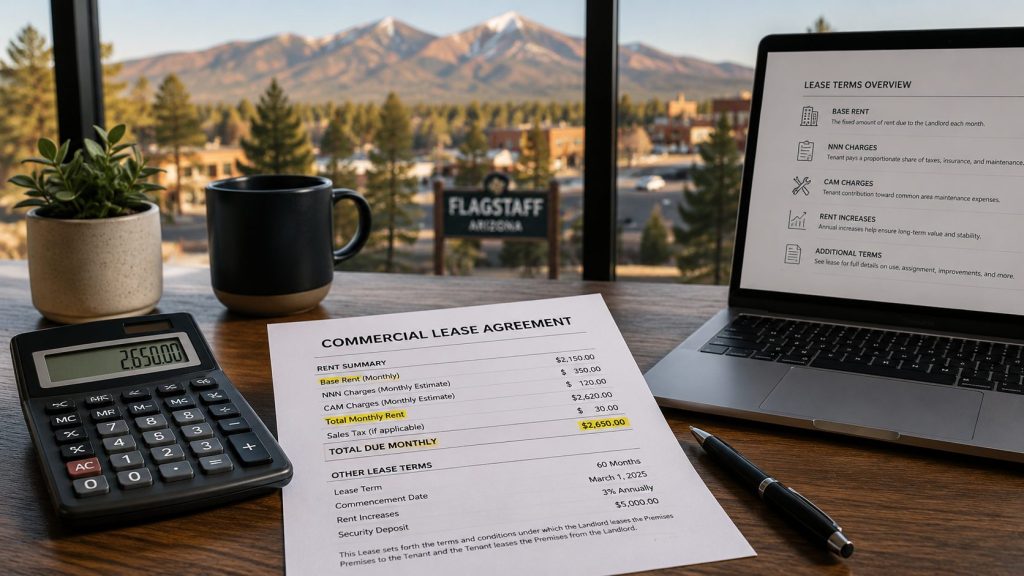
Commercial lease terms in Flagstaff affect your real monthly rent by deciding which expenses you pay beyond base rent, including taxes, insurance, maintenance, utilities, and common area costs.

This is where a lease that looks affordable can become expensive. A base rent number may not include operating expenses. In a multi-tenant retail center, those additional charges may include parking lot maintenance, landscaping, exterior lighting, snow removal, repairs, management fees, and shared utilities.

According to OU Legal, tenants should understand rent escalations, CAM charges, tenant improvements, lease length, renewal options, and hidden operating expenses before signing a commercial lease.

Here are simplified examples of common lease structures you may see:

Gross lease

A gross lease generally means the tenant pays one agreed rent amount, while the landlord covers many property expenses. This can be easier to budget, but the rate may be higher because the landlord is absorbing more risk.

Modified gross lease

A modified gross lease splits expenses between landlord and tenant. For example, the tenant might pay base rent plus utilities and interior maintenance, while the landlord handles taxes, insurance, and exterior maintenance. This structure is common, but every modified gross lease is different.

NNN lease

A triple net lease, often called NNN, usually means the tenant pays base rent plus a share of property taxes, insurance, and common area maintenance. This can work well when the numbers are clear, but tenants should ask for expense history and estimates before committing.

Percentage rent

A percentage rent clause is more common in retail. It may require a tenant to pay base rent plus a percentage of sales above a certain breakpoint. This can be reasonable for the right retail concept, but the reporting requirements need to be clear.

Here is a simple example. If a 1,500-square-foot space is quoted at $24 per square foot annually, the base rent is about $36,000 per year, or $3,000 per month. If NNN expenses add $7 per square foot annually, that adds $10,500 per year, or $875 per month. Before utilities, insurance, internet, signage, furniture, and improvements, the monthly occupancy cost would already be about $3,875.

Commercial lease terms Flagstaff tenants should review carefully include:

  • Rent escalations and annual increases
  • CAM charge definitions and caps
  • HVAC repair and replacement responsibility
  • Snow and ice removal responsibility
  • Signage rights and sign permit obligations
  • Security deposit and personal guarantee language
  • Default, cure period, and late fee clauses
  • Renewal option deadlines
  • Assignment and sublease rights
  • Restoration obligations at move-out

Want the simplest way to avoid a costly surprise? Ask for a written lease cost summary before signing.

Takeaway: Your base rent is not your full rent. Always calculate the all-in monthly number.

ChatGPT Image May 15, 2026, 02_06_14 AM

What should you know about parking before signing a Flagstaff office lease or retail lease?

Before signing a Flagstaff office lease or retail lease, tenants should confirm how customers, employees, vendors, and delivery drivers will park during normal business hours.

Parking can make or break a commercial location. A storefront with strong visibility may still struggle if customers cannot easily stop, shop, and leave. An office with a great layout may frustrate employees if all-day parking is unclear. A medical or service business may need higher parking turnover than a traditional office.

Discover Flagstaff explains that ParkFlag manages on-street parking throughout downtown, including employee and resident permits, plus free two-hour time-limited parking for visitors. 

If you are considering downtown Flagstaff, ask how the parking program affects your staff and customers. If you are comparing a suburban retail center, ask whether parking is shared, reserved, limited by time, or affected by neighboring tenants. If you are reviewing an industrial or flex space, ask about truck access, loading, turning radius, and overnight vehicle rules.

Ask these parking questions before signing:

  • How many parking spaces are included, if any?
  • Are spaces reserved, shared, or first-come, first-served?
  • Are customer spaces time-limited?
  • Are employee parking permits available nearby?
  • Is ADA parking compliant and conveniently located?
  • Are delivery trucks allowed at the times your business needs?
  • Does the lease guarantee parking rights in writing?
  • Who maintains, lights, plows, and repairs the lot?
  • Are there restrictions on overnight vehicles, trailers, or fleet parking?

Parking is not just a convenience issue. It affects sales, employee retention, appointment scheduling, ADA access, and customer experience. For restaurants, salons, clinics, fitness studios, and high-traffic retail, the parking conversation should happen early, not after you fall in love with the space.

Takeaway: If parking matters to your revenue, make sure your parking rights are written into the lease.

ChatGPT Image May 15, 2026, 02_11_24 AM

How do use restrictions and zoning affect commercial space for lease in Flagstaff AZ?

Use restrictions and zoning affect commercial space for lease in Flagstaff AZ by determining what business activities are allowed in the space and what approvals may be needed before opening.

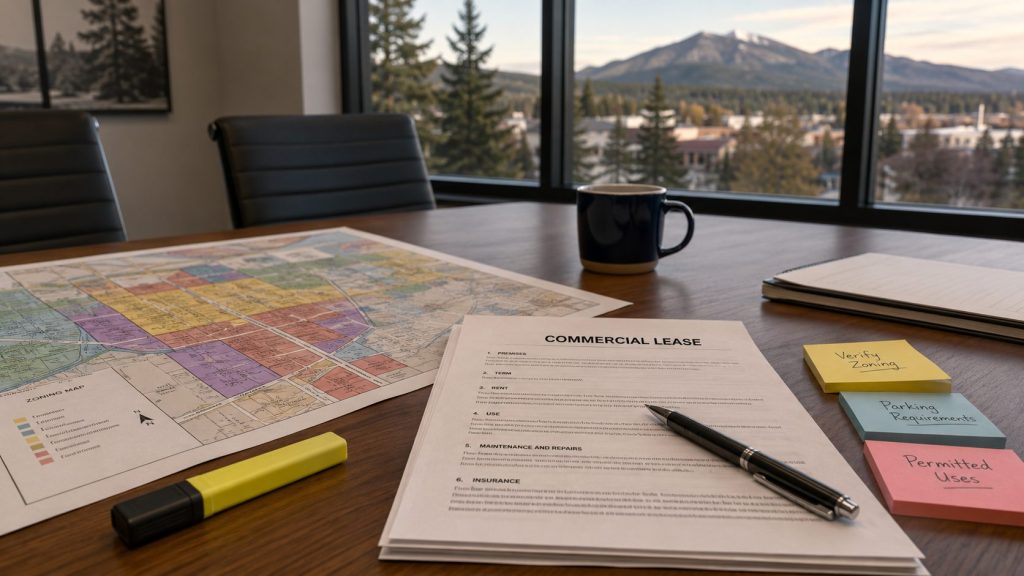
This is one of the most important parts of commercial leasing. A space can be the right size, the right price, and the right location, but still be wrong if your use is not allowed. For example, a retail shop, restaurant, medical office, fitness studio, daycare, light industrial user, and professional office may each trigger different requirements.

The City of Flagstaff states that its Zoning Code regulates the use and development of land within the city and is intended to protect the health, safety, and welfare of people living, working, doing business, and visiting in Flagstaff. 

Use restrictions can come from more than one place:

  • City zoning: What the local zoning district allows.
  • Lease permitted use clause: What the landlord allows in the lease.
  • Existing tenant exclusives: What other tenants may have already negotiated.
  • Property rules: Hours, noise, odors, signage, storage, trash, patio areas, and deliveries.
  • Building limitations: Grease traps, ventilation, sprinklers, electrical capacity, plumbing, and ADA access.
  • Historic or design rules: Possible exterior, signage, or façade considerations in certain areas.

According to Hollander Real Estate Law, a permitted use clause defines and limits the type of business a tenant can operate in the leased premises, and it can affect tenant mix, competition, flexibility, and property value. Source: Hollander Real Estate Law, https://hollanderpllc.com/2025/03/a-guide-to-negotiating-a-permitted-use-clause-in-a-commercial-lease/

Here is where tenants get stuck. They describe their business too narrowly in the lease. A coffee shop tenant might later want to add packaged goods, events, catering, or online order pickup. A wellness office might later want to add retail products, classes, or additional service providers. If the permitted use language is too tight, growth can become a lease problem.

A better approach is to describe your use accurately but with reasonable flexibility. This should be reviewed by your attorney and leasing advisor. The goal is not to create vague language. The goal is to avoid boxing your business into a use description that stops normal growth.

Takeaway: Confirm both zoning and lease-permitted use before spending money on design, signage, or build-out.

ChatGPT Image May 15, 2026, 02_21_26 AM

How should tenants evaluate location fit for office, retail, and service businesses in Flagstaff?

Tenants should evaluate location fit by matching the space to customer behavior, employee access, visibility, nearby demand drivers, parking, and the operating needs of the business.

A great location for one tenant can be a poor fit for another. A boutique may want walkability and visitor traffic. A contractor may need yard space, loading, and easy highway access. A medical office may need ADA access, convenient parking, and a calm arrival experience. A professional office may care most about commute time, client convenience, and nearby amenities.

The City of Flagstaff Economic Development Program says it promotes sustainable retail, commercial business, and industrial growth while providing support, feedback, programs, and business resources.

709f03b6-9757-401c-8e63-cda9a364065a

What lease term examples should Flagstaff tenants consider before committing?

Flagstaff tenants should consider lease terms that match their business stage, build-out investment, cash flow, and need for flexibility.

A brand-new business may not want the same commitment as an established medical office or restaurant. A short-term lease may reduce risk but limit stability. A longer lease may help justify tenant improvements but can create pressure if sales ramp up slowly.

Raleigh Durham CRE’s tenant checklist recommends reviewing lease type, operating expenses, lease length, renewal options, tenant improvements, exit clauses, property condition, and professional guidance before signing

How can an AI Certified leasing advisor help tenants compare commercial space in Flagstaff?

An AI Certified leasing advisor can help tenants organize listing options, compare lease details, summarize site pros and cons, and move through the search process with more clarity and speed.

Technology does not replace local judgment. It supports it. When used carefully, AI tools can help sort available spaces, compare clauses, organize tour notes, draft question lists, and prepare side-by-side summaries so tenants can make better decisions faster.

For commercial tenants, that can mean less confusion and fewer missed details. Instead of bouncing between listings, screenshots, emails, and lease drafts, you can work from a clearer decision framework.

Here is how AI-supported leasing guidance can help:

  • Listing comparison: Organize spaces by size, rent type, location, parking, and use fit.
  • Lease review preparation: Flag questions to discuss with your attorney, landlord, or broker.
  • Tour notes: Summarize pros, cons, photos, and follow-up items after each showing.
  • Location research: Compare nearby amenities, access points, and customer convenience factors.
  • Marketing fit: Think through how the location supports customer visibility and local awareness.
  • Time savings: Reduce repetitive research so more time goes into strategy and negotiation.

The human side still matters most. AI will not walk the space, notice awkward customer flow, understand landlord responsiveness, or feel how difficult a delivery route may be during a busy afternoon. That is why the best approach blends local leasing experience with smarter organization.

Takeaway: AI-supported guidance helps tenants compare more clearly, but local expertise still drives the final recommendation.

Final takeaways for leasing commercial space in Flagstaff

Leasing commercial space in Flagstaff works best when you compare the complete business fit, not just the rent or the photos.

The right space should support your customers, employees, operations, budget, and long-term goals. That means reviewing rent structure, parking, use restrictions, zoning, signage, build-out, renewal rights, and total monthly cost before you sign.

Ready to compare commercial space for lease in Flagstaff AZ with more confidence?

Talk with a local leasing advisor before you sign. I can help you compare spaces, ask better lease questions, and narrow your options based on what your business actually needs.

FAQ

What is the average cost of commercial space for lease in Flagstaff AZ?

The cost of commercial space for lease in Flagstaff AZ depends on property type, location, size, lease structure, and included expenses. Current listing platforms show a wide range of asking rates across office, retail, industrial, flex, and medical spaces, so tenants should compare all-in monthly cost rather than base rent alone. Always ask whether the rent is gross, modified gross, NNN, or another structure.

Is a Flagstaff office lease different from a retail lease?

Yes, a Flagstaff office lease usually focuses more on layout, parking, client access, utilities, and maintenance, while a retail lease often adds signage, visibility, storefront design, customer parking, sales use, and sometimes percentage rent. Retail tenants may also need to review exclusives, co-tenancy clauses, and operating restrictions more closely. The right lease structure depends on how the business uses the space.

What does NNN mean in a commercial lease?

NNN means triple net, which usually means the tenant pays base rent plus a share of property taxes, insurance, and common area maintenance. These expenses can change over time, so tenants should request estimates and historical expenses when available. NNN leases can be workable, but the details need to be clear before signing.

Can I change the use of a commercial space after signing a lease?

You may be able to change the use, but only if the lease, landlord, zoning, and any applicable approvals allow it. A permitted use clause can limit what activities are allowed in the space. If you think your business may expand services, add retail products, host events, or change operations, discuss that before signing.

Do I need a lawyer before signing a commercial lease in Flagstaff?

It is wise to have a qualified real estate attorney review any commercial lease before signing. A leasing advisor can help compare spaces, negotiate business terms, and identify practical questions, but an attorney helps review legal rights, obligations, and risk. Commercial leases can create long-term financial commitments, so professional review is worth the time.

Leasing commercial space in Flagstaff works best when you compare the complete business fit, not just the rent or the photos.

The right space should support your customers, employees, operations, budget, and long-term goals. That means reviewing rent structure, parking, use restrictions, zoning, signage, build-out, renewal rights, and total monthly cost before you sign.

Ready to compare commercial space for lease in Flagstaff AZ with more confidence?

Talk with a local leasing advisor before you sign. I can help you compare spaces, ask better lease questions, and narrow your options based on what your business actually needs.

Commercial Space For Lease In Flagstaff AZ: What Tenants Should Know

Commercial Space For Lease In Flagstaff AZ: What Tenants Should Know Commercial space for lease in Flagstaff AZ can look simple online, but the real decision comes down to rent structure, parking, permitted use, lease term, and whether the location actually supports how your business operates. Here is the part many tenants miss: two spaces […]
Read More

Flagstaff Commercial Real Estate 101

Flagstaff Commercial Real Estate 101 Flagstaff Commercial Real Estate 101 For Business Owners Buying, selling, or leasing a commercial property can feel like a big step. Maybe you need a storefront, office, warehouse, medical space, or land for your next project. Maybe you already own a building and want to know what it may be […]
Read More

Meet Mike Konefal: The Strategic Mind Behind Smart Commercial Real Estate Decisions

Meet Mike Konefal: The Strategic Mind Behind Smart Commercial Real Estate Decisions Commercial real estate is not about buildings. It’s about leverage. Most investors and business owners start by looking at listings, cap rates, or lease prices. That’s natural. But the truth is, success in commercial real estate is rarely about what’s visible on the […]
Read More

Flagstaff Commercial Real Estate 101

Flagstaff Commercial Real Estate 101 For Business Owners

Buying, selling, or leasing a commercial property can feel like a big step. Maybe you need a storefront, office, warehouse, medical space, or land for your next project. Maybe you already own a building and want to know what it may be worth.

Either way, understanding the basics of Flagstaff commercial real estate can help you make smarter moves.

Flagstaff is not just a mountain town. It is also a business hub for Northern Arizona. The city has a population of about 77,539 people, and more than half of adults age 25 and older have a bachelor’s degree or higher. That can matter for business owners who care about workforce, customers, and long-term growth.

So, where should you start?

What Is Commercial Real Estate?

Commercial real estate is property used for business. It is different from a home because the main goal is usually to run a business, earn rent, or invest.

Common types of commercial real estate include:

  • Retail shops
  • Office buildings
  • Medical offices
  • Restaurants
  • Warehouses
  • Mixed-use buildings
  • Commercial land
  • Multi-family investment properties

In Flagstaff, you may see commercial space near downtown, Route 66, Milton Road, University areas, industrial zones, and other business corridors.

Each area can serve a different purpose. A retail shop may need strong foot traffic. A warehouse may need easy truck access. A professional office may need parking and a quiet setting.

Why Flagstaff Commercial Real Estate Is Unique

Flagstaff has a different feel from many Arizona cities. It has a strong tourism base, a major university, local neighborhoods, outdoor traffic, and regional business demand.

Northern Arizona University also adds steady activity to the area. In Fall 2024, NAU enrolled 28,468 students, with 21,398 students located on the Flagstaff campus. That can support demand for housing, food, retail, services, and nearby business space.

Flagstaff also has a strong retail and service economy. The U.S. Census Bureau reported about $2.9 billion in total retail sales for 2022 and more than $601 million in accommodation and food services sales. These numbers show why location can matter so much for local businesses.

Buying Vs Leasing Commercial Property In Flagstaff

One of the first questions business owners ask is simple.

Should you buy or lease?

The answer depends on your goals, budget, and business plan.

Leasing May Be A Good Fit If You Want Flexibility

Leasing can work well if your business is new, growing, or changing. It may also help if you want to test a location before making a larger investment.

Leasing may help you:

  • Lower your upfront cost
  • Move faster
  • Try a new market
  • Keep more cash for your business
  • Avoid some building repair duties

However, lease terms matter. You should understand the rent, lease length, renewal options, repairs, taxes, insurance, and allowed business use before signing.

Buying May Be A Good Fit If You Want Control

Buying commercial property can make sense if you want long-term stability. It can also help if you want to build equity over time.

Buying may help you:

  • Control your space
  • Lock in a location
  • Build long-term value
  • Rent extra space to tenants
  • Make improvements with more freedom

However, buying also comes with more responsibility. You may need a larger down payment, inspections, financing, insurance, maintenance plans, and a clear exit strategy.

What To Look For In A Commercial Property

A good commercial property is not just about the building. It is about how the space supports your goal.

Before you buy or lease, look at these key points.

Location And Access

Can customers, staff, or vendors reach the property easily?

For a retail business, visibility and traffic can be important. For an office, parking and convenience may matter more. For industrial use, loading areas and road access may be key.

Ask yourself this question.

Will this location make daily business easier?

Zoning And Allowed Use

Not every property can be used for every business. Zoning rules decide what can happen on the property.

For example, a space that works for an office may not work for a restaurant. A warehouse may have rules about noise, traffic, or outdoor storage.

The City of Flagstaff has economic development resources and programs that support retail, commercial, and industrial growth. It is still important to confirm zoning, permits, fees, and other local rules before moving forward.

Parking And Traffic Flow

Parking can make or break a commercial property.

A great space may not work if customers cannot find parking or if deliveries are hard to manage. Look at how people enter, exit, walk, and park.

This is extra important for restaurants, medical offices, shops, and service businesses.

Building Condition

A property may look good at first, but hidden issues can cost money.

Check the roof, plumbing, electrical, heating, cooling, windows, flooring, signs, and ADA access. Also ask about past repairs and future maintenance.

A good inspection can help you avoid surprises.

Lease Or Purchase Terms

The price is only one part of the deal.

For a lease, review rent increases, common area fees, repairs, renewal options, and early exit terms.

For a purchase, review financing, inspections, title, environmental concerns, and closing costs.

Small details can have a big impact later.

Common Mistakes To Avoid

Commercial real estate can be exciting, but rushing can lead to costly mistakes.

Here are a few to avoid.

Choosing A Property Based Only On Price

The lowest price is not always the best deal. A cheaper space may need major repairs, have weak access, or sit in the wrong location for your customers.

Instead, think about total value.

Does the property help your business grow?

Skipping Local Market Research

Flagstaff is a local market with its own patterns. Inventory, pricing, demand, and property types can change. Commercial listing platforms show office, retail, industrial, multi-family, and land options in the Flagstaff area, which means buyers and tenants should compare spaces carefully.

Not Planning For Growth

A space may fit today, but will it still work in two or three years?

Think about staff, storage, parking, customer volume, and future equipment. Moving again can be costly, so plan ahead when possible.

Not Working With A Local Commercial Real Estate Professional

Commercial deals have many moving parts. A local commercial real estate advisor can help you understand pricing, lease terms, property use, location pros and cons, and negotiation options.

This can save time, reduce stress, and help you avoid mistakes.

Why Local Knowledge Matters In Flagstaff

Flagstaff has many property types and business areas. Downtown may be right for one business. Route 66 may be better for another. A medical office may need a different setup than a retail shop. An investor may care more about income, tenant history, and future value.

That is why local knowledge matters.

Choose Flagstaff notes that the city offers business relocation and expansion support, including help with planning, licenses, fees, and taxes. This kind of local support can be helpful for business owners looking at a move or expansion.

A local commercial real estate expert can help you look beyond the listing and ask better questions.

Ready To Explore Flagstaff Commercial Real Estate?

The right commercial property can support your business, serve your customers, and help you plan for the future. The key is to move with a clear plan.

Start with your goal. Know your budget. Study the location. Review the terms. Ask questions before you sign.

Looking for help with Flagstaff commercial real estate? Reach out today to ask for a local commercial property consult and learn what options may fit your business, investment, or property goals.

Meet Mike Konefal: The Strategic Mind Behind Smart Commercial Real Estate Decisions

Commercial real estate is not about buildings.

It’s about leverage.

Most investors and business owners start by looking at listings, cap rates, or lease prices. That’s natural. But the truth is, success in commercial real estate is rarely about what’s visible on the surface.

It’s about structure. Timing. Positioning. Risk control.

That’s where Mike Konefal comes in.

If you are an investor seeking strong returns, a business owner securing space, or a lessor maximizing value, your results depend on who is guiding the strategy behind the deal.


Who Is Mike in Commercial Real Estate?

Mike is a commercial real estate advisor who works with serious investors, buyers, lessors, and operators who view property as a strategic asset, not just a transaction.

He understands what high-level decision-makers care about:

  ● Risk-adjusted returns

  ● Long-term appreciation

  ● Strong tenant positioning

  ● Lease durability

  ● Exit strategy

Commercial real estate rewards clarity. Mike brings that clarity to every deal.


Why Do Serious Investors Work With Mike?

Because guessing is expensive.

In commercial real estate, small miscalculations compound over time. A weak tenant profile, poor lease structure, or misjudged location can quietly erode performance.

Mike approaches every acquisition and lease through an ownership lens.

That means evaluating:

  ● Income stability

  ● Market demand drivers

  ● Tenant quality

  ● Future flexibility

  ● Downside protection

He does not just ask, “Is this a good deal?”

He asks, “Is this the right strategic move for where you are going?”

That distinction changes outcomes.


What Does Mike Do for Commercial Investors?

Mike helps investors analyze, acquire, and optimize commercial assets with discipline and foresight.

1. Acquisition Strategy

Before capital is deployed, Mike ensures alignment between the property and your long-term portfolio objectives.

2. Market and Asset Evaluation

He studies local market conditions, competitive positioning, and income sustainability so decisions are grounded in data, not emotion.

3. Lease and Income Analysis

Commercial property performance lives and dies by its leases. Mike reviews tenant structures, renewal terms, and escalation clauses to protect cash flow.

4. Negotiation and Deal Structuring

Negotiation is not about aggression. It is about leverage. Mike structures transactions to reduce exposure and maximize upside.

The result: disciplined investments built for long-term performance.


How Does Mike Help Business Owners and Tenants?

Leasing space is not just about monthly rent.

It impacts operational efficiency, brand visibility, staffing, customer access, and future growth.

Many tenants focus on square footage.

Mike focuses on strategic positioning.

He helps business owners:

  ● Negotiate favorable lease terms

  ● Understand long-term cost implications

  ● Evaluate expansion flexibility

  ● Protect operational stability

The wrong lease can quietly restrict growth. The right one can accelerate it.

That is not luck. It is structure.


What Makes Mike Different From Other Commercial Brokers?

Many brokers focus on transactions.

Mike focuses on outcomes.

He approaches every engagement with one frame:

Commercial real estate is leverage when structured correctly.

This means:

  ● Thinking beyond the current market cycle

  ● Evaluating exit strategy from day one

  ● Identifying hidden risks others overlook

  ● Protecting capital as carefully as he grows it

Investors and operators who work with Mike value strategic thinking over sales pressure.

They want insight. Discipline. Accountability.

They get it.


Who Is the Right Fit for Mike?

Mike works best with individuals and organizations who:

  ● View commercial property as a wealth-building vehicle

  ● Understand that structure matters more than hype

  ● Value informed decision-making

  ● Seek long-term positioning, not short-term noise

Whether you are acquiring your first asset or optimizing a portfolio, alignment matters.

When strategy is clear, decisions become simpler. Confidence increases. Execution becomes precise.


The Core Truth About Commercial Real Estate

Most people believe success comes from finding “the deal.”

In reality, success comes from understanding the structure behind the deal.

That structure determines:

  ● Cash flow durability

  ● Risk exposure

  ● Exit flexibility

  ● Asset appreciation potential

When those elements align, commercial real estate becomes powerful leverage.

Mike’s role is to make that alignment visible and achievable.


Book an Appointment With Mike

If you are evaluating an acquisition, negotiating a lease, or optimizing your commercial portfolio, the next step is clarity.

Strategic conversations change trajectories.

Book an appointment with Mike today and begin structuring your commercial real estate decisions with precision and confidence.


Frequently Asked Questions

What types of commercial properties does Mike handle?

Mike works with office, retail, industrial, and mixed-use assets, advising both investors and owner-users.

Does Mike work with out-of-state investors?

Yes. He provides local insight, due diligence support, and structured evaluation for remote investors seeking reliable representation.

Can Mike assist with lease negotiations?

Absolutely. Mike reviews and negotiates commercial lease terms to protect financial and operational flexibility.

Is Mike suitable for first-time commercial investors?

Yes. He guides new investors through acquisition analysis, lease structure review, and long-term strategy planning.

More Articles

Commercial Space For Lease In Flagstaff AZ: What Tenants Should Know

By Mike Konefal | May 14, 2026

Commercial Space For Lease In Flagstaff AZ: What Tenants Should Know Commercial space for lease in Flagstaff AZ can look simple online, but the real decision comes down to rent structure, parking, permitted use, lease term, and whether the location actually supports how your business operates. Here is the part many tenants miss: two spaces […]

Flagstaff Commercial Real Estate 101

By Mike Konefal | May 8, 2026

Flagstaff Commercial Real Estate 101 Flagstaff Commercial Real Estate 101 For Business Owners Buying, selling, or leasing a commercial property can feel like a big step. Maybe you need a storefront, office, warehouse, medical space, or land for your next project. Maybe you already own a building and want to know what it may be […]